

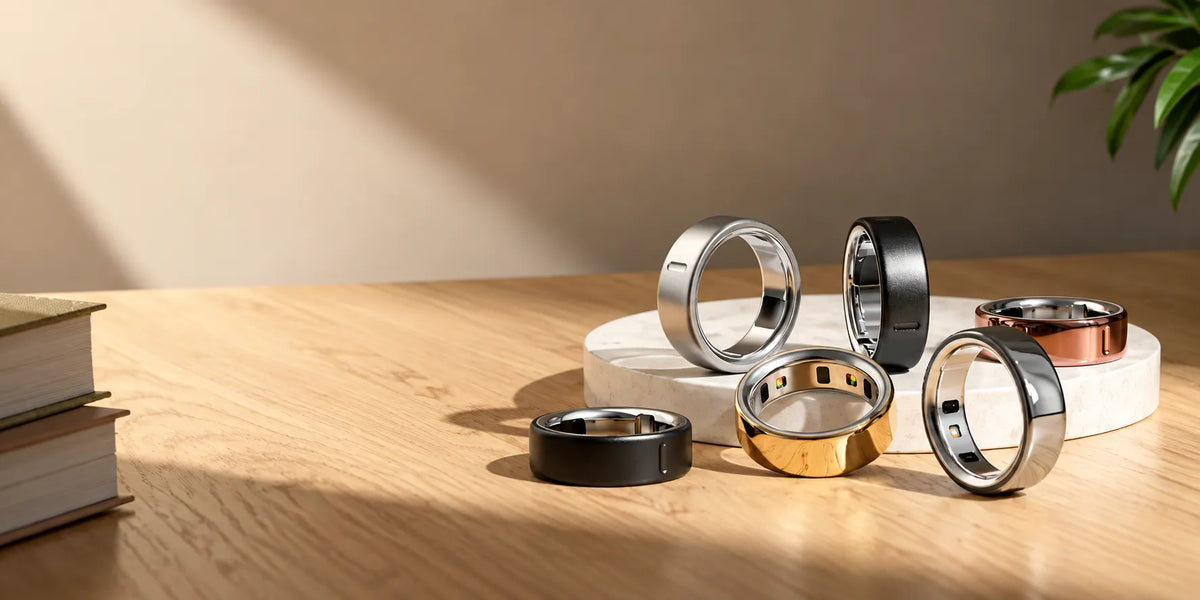
Imagine wearing a small ring that quietly records signals from your body while you go about your day. Unlike a smartwatch, a smart ring can operate without a screen or constant notifications, collecting physiological and movement data in the background.
At the center of this technology is the smart ring — a wearable device that combines miniature sensors, wireless connectivity, and software to turn physical signals into information you can understand.
The process can be summarized as:
Depending on the device, sensors can collect information related to heart rate, movement, skin-temperature changes, and blood oxygen. Software then processes those signals to generate metrics and trends related to areas such as sleep, activity, recovery, and overall wellness. Oura Ring 5, for example, uses optical sensors, a temperature sensor, and an accelerometer as part of its sensing system.
But how does this process actually work?
1. What Is a Smart Ring?
A smart ring is a wearable electronic device designed to be worn on the finger while collecting data through embedded sensors.
Unlike a smartwatch, a smart ring typically does not rely on a large display for interaction. Instead, much of the information it collects is processed and presented through a connected smartphone application.
Smart rings can vary considerably in their hardware and capabilities. Depending on the model, they may track metrics such as heart rate, movement, skin-temperature variations, blood oxygen, sleep-related measurements, and other wellness indicators.
The finger is also an interesting location for wearable sensing. Optical sensors can use changes in reflected light to detect variations associated with blood volume and pulse. A snug fit can help maintain consistent contact between the sensors and skin, although the quality of measurements can still vary depending on fit, movement, skin characteristics, and the specific device.
Many smart rings also communicate wirelessly with a smartphone. For example, Oura Ring 5 is designed for continuous wear and combines its onboard sensors with software that analyzes the collected information.

2. What Sensors Are Inside a Smart Ring?
Inside a smart ring is a compact collection of sensors designed to capture different types of physical signals.
The exact sensor configuration varies between manufacturers and models, but common technologies include optical sensors, temperature sensors, and motion sensors.
Optical PPG sensors
Photoplethysmography, commonly called PPG, uses light to detect changes in blood volume beneath the skin.
A PPG system typically combines light emitters with photodetectors. As blood moves through the tissue with each heartbeat, the amount of light absorbed or reflected changes. Software can then analyze these changes to estimate measurements such as heart rate.
Oura Ring 5, for example, uses tri-LED light emitters and photodetectors as part of its sensing architecture.
Some devices also use optical sensing for blood oxygen measurements. These measurements are estimates derived from optical signals rather than a direct laboratory measurement.
Temperature sensors
Smart rings can also contain digital temperature sensors.
Rather than functioning exactly like a clinical thermometer, wearable temperature sensors can monitor changes or trends in temperature-related measurements over time. These trends can provide additional context alongside sleep, activity, and other measurements.
For example, Oura Ring 5 uses a digital temperature sensor to measure variations in body temperature.
Accelerometers
An accelerometer measures movement and changes in motion.
In a smart ring, movement data can help software distinguish periods of activity from periods of relative inactivity. Combined with other signals, movement information can contribute to estimates related to activity and sleep.
Oura Ring 5, for example, includes an accelerometer for tracking movement and activity.

3. How Does a Smart Ring Collect Data From Your Body?
The process begins when the sensors interact with the body.
For optical sensing, light is directed toward tissue beneath the skin. Because blood volume changes as the heart beats, the reflected light also changes. Photodetectors capture these variations and convert them into signals that can be processed by the device.
At the same time, other sensors can collect movement or temperature-related information.
The result isn't immediately a polished health score. Instead, the device initially collects raw sensor signals.
Those signals can contain noise caused by movement, changes in sensor contact, environmental conditions, and other factors. This is why data processing is an important part of wearable technology.
4. From Raw Signals to Meaningful Data
Raw sensor measurements aren't necessarily useful on their own.
Imagine a smart ring recording an optical signal while you're running. Your finger is moving, the ring may shift slightly, and the optical signal can change as a result.
Software therefore has to process the incoming information before turning it into a useful metric. A simplified version of this process looks like this:
- Signal collection — sensors capture optical, temperature, and movement signals.
- Digitization — electronic components convert sensor outputs into digital information.
- Signal processing — algorithms help reduce noise and identify meaningful patterns.
- Data combination — information from multiple sensors can be analyzed together.
- Metric generation — the processed information becomes measurements or estimates such as heart rate, activity, or sleep-related metrics.
- Long-term analysis — software can compare measurements over time to identify personal trends.
This last step is particularly important. A single measurement can provide a snapshot, while measurements collected repeatedly can help reveal changes relative to a person's own historical patterns.

5. Where Does AI Come In?
Not every smart ring uses AI in exactly the same way, and manufacturers may use different algorithms and terminology.
However, modern wearable platforms increasingly use sophisticated algorithms and machine-learning techniques to interpret large amounts of sensor data.
Instead of looking at one signal independently, software can combine information from multiple sensors. For example, sleep analysis may use combinations of movement, heart-related signals, and other physiological measurements to estimate when a person is asleep and to classify different sleep periods.
Activity recognition can similarly use movement patterns to identify periods of exercise or other physical activity.
Key distinction: the sensors collect the signals; software interprets those signals. AI and machine learning can be part of that interpretation process, particularly when the system needs to recognize patterns across large amounts of historical data.
Research into smart rings and physiological measurements has found promising results for several physiological measurements, but researchers also emphasize that accuracy varies by metric, device, population, and use case.

6. What Can a Smart Ring Tell You?
The answer depends on the specific smart ring. Common smart-ring applications include sleep tracking, activity monitoring, heart-rate measurements, temperature trends, and other wellness metrics.
Heart rate and HRV
Some smart rings continuously or periodically track heart rate throughout the day and night.
Certain devices also calculate heart rate variability (HRV), which describes variation in the timing between heartbeats. HRV can provide useful context about physiological patterns, but it should not be interpreted as a standalone diagnosis of stress, illness, or another medical condition.
Sleep
Sleep is one of the major applications of smart-ring technology. A smart ring can combine movement and physiological signals to estimate sleep duration, periods of wakefulness, and different sleep stages.
However, sleep-stage estimates should be treated as estimates rather than replacements for clinical sleep testing. Research comparing finger-worn devices with polysomnography has found promising performance for sleep/wake classification while also identifying continuing challenges in accurately distinguishing individual sleep stages.
Some research has found Oura Ring measurements comparable with clinical sleep-study measurements for several commonly measured sleep parameters, but that does not make a consumer smart ring a substitute for a medical sleep study.
Activity and recovery
Movement sensors allow smart rings to track activity throughout the day. Depending on the device and software, this information can contribute to activity summaries, exercise recognition, recovery measurements, or personalized recommendations.
These metrics are best understood as tools for tracking patterns and supporting everyday wellness decisions — not as medical assessments.
Temperature trends
Temperature-related measurements can add another layer of context to other biometric information. For example, changes in temperature trends can be considered alongside sleep, activity, and other measurements.
Some smart-ring platforms also use temperature data for women's health and cycle-related features. The exact functionality depends on the device and software.

7. Oura Ring as a Real-World Example
One way to understand smart-ring technology is to look at a real-world example, such as the Oura Ring.
Oura Ring is one of the best-known smart-ring platforms, combining miniature sensors with software designed to help users understand sleep, activity, readiness, stress, and other health-related trends.
Oura Ring 5, released in 2026, uses a fully titanium design with optical sensors, a digital temperature sensor, and an accelerometer. Oura states that Ring 5 has 40% less volume than Ring 4 and uses 12 signal pathways in its redesigned sensing architecture.
Oura's software also provides features such as sleep analysis, heart-rate tracking, blood oxygen sensing, stress measurements, activity detection, cardiovascular metrics, and other health and wellness insights.
These features demonstrate an important principle of smart-ring technology:
That distinction is what makes a smart ring more than simply a collection of sensors.
8. Why Does Turning Body Signals Into Data Matter?
Your body changes throughout the day. Heart rate can change with activity. Movement changes as you exercise or rest. Temperature-related measurements can fluctuate. Sleep patterns can vary from one night to another.
A smart ring creates a way to observe some of these changes over longer periods. Instead of relying only on an occasional measurement, users can look at trends across days, weeks, or months.
For example, someone might notice changes in their sleep duration, activity levels, resting heart rate, or other personal metrics over time. These trends can help users become more aware of their habits and routines.
However, wearable data should be treated as personal health and wellness information, not as a definitive medical assessment. Oura itself states that its Ring is not a medical device and is not intended to diagnose, treat, cure, monitor, or prevent medical conditions or illnesses.
9. The Future of Smart Ring Technology
Smart-ring technology is still developing. Future devices may become smaller, more power-efficient, and capable of collecting a wider range of physiological signals.
Researchers are also investigating how finger-worn devices could support applications beyond everyday wellness tracking. A 2025 systematic review of smart rings in clinical medicine found promising evidence across areas including heart rate, HRV, sleep, and other physiological applications, while also emphasizing that clinical utility and measurement accuracy vary across use cases.
Potential areas of development include:
- More sophisticated sensor technology
- Better signal processing
- More personalized algorithms
- Improved sleep and activity analysis
- Greater integration with other health platforms
- Longer battery life
- More privacy-conscious data processing
- Potential clinical applications supported by further research and validation
The important point is that these are areas of development, not guarantees of what every future smart ring will be able to do.
As wearable technology becomes more sophisticated, the challenge will not simply be collecting more data. It will be turning that data into information that is accurate, understandable, useful, and responsibly communicated.
Frequently Asked Questions
What is a smart ring?
A smart ring is a wearable electronic device worn on the finger that uses sensors and software to collect and interpret information such as movement, heart-related signals, and temperature-related measurements.
How does a smart ring work?
A smart ring uses miniature sensors to collect signals from the body. Software then processes those signals and can turn them into metrics and trends related to areas such as sleep, activity, and wellness.
What does a smart ring track?
Depending on the model, a smart ring may track heart rate, HRV, movement, temperature-related measurements, blood oxygen, sleep-related metrics, activity, and other wellness indicators. The exact features vary by manufacturer and device.
What sensors are used in a smart ring?
Common sensor technologies include optical PPG sensors, temperature sensors, and accelerometers. The exact combination depends on the smart-ring model.
Are smart rings accurate?
Accuracy varies by device, measurement, testing conditions, and individual user. Research has found strong performance for some physiological measurements, but results are not identical across every metric. Smart-ring data is best viewed as an estimate or trend rather than an infallible measurement.
Can a smart ring track sleep?
Yes. Many smart rings are designed to estimate sleep duration, wake periods, and sleep stages using combinations of movement and physiological signals. However, consumer sleep tracking should not be treated as equivalent to a clinical sleep study. Research continues to show differences in accuracy between sleep/wake detection and detailed sleep-stage classification.
Can a smart ring measure blood pressure?
This depends on the device. Some smart-ring platforms provide information related to blood-pressure patterns, but this should not automatically be interpreted as a direct blood-pressure measurement. For example, Oura's Blood Pressure Signals feature is designed to analyze overnight patterns and trends rather than replace a conventional blood-pressure cuff.
Can a smart ring diagnose a medical condition?
A consumer smart ring should not automatically be considered a diagnostic medical device. For example, Oura explicitly states that Oura Ring is not intended to diagnose, treat, cure, monitor, or prevent medical conditions or illnesses. If you are concerned about a health symptom or medical measurement, consult an appropriately qualified healthcare professional.
How is a smart ring different from a smartwatch?
A smartwatch typically combines health sensors with a screen, notifications, apps, and other interactive features. A smart ring focuses more heavily on discreet, background sensing in a much smaller form factor. The better choice depends on whether you prioritize screen-based interaction, notifications, or passive health and wellness tracking.
Does a smart ring use AI?
Some smart-ring platforms use machine learning and other advanced algorithms to interpret sensor data. AI is not what physically measures your body — sensors collect the underlying signals, while software and algorithms process those signals and can identify patterns that become useful metrics or insights.
Conclusion
A smart ring may look like a simple piece of jewelry, but underneath its small form factor is a combination of sensors, electronics, software, and data processing.
The process starts with signals from the body. Optical sensors can detect changes associated with blood flow, temperature sensors can monitor temperature-related variations, and motion sensors can capture movement. Software then processes those signals to produce measurements, trends, and wellness insights.
The real value of a smart ring is not simply the amount of data it collects. It is the ability to turn complex signals into information that people can understand and use to become more aware of their everyday habits.
As sensors, algorithms, and wearable technology continue to develop, smart rings may become even more capable. But the most important standard will remain the same: the data should be presented accurately, responsibly, and with a clear understanding of the difference between wellness insights and medical diagnosis.

Share: