

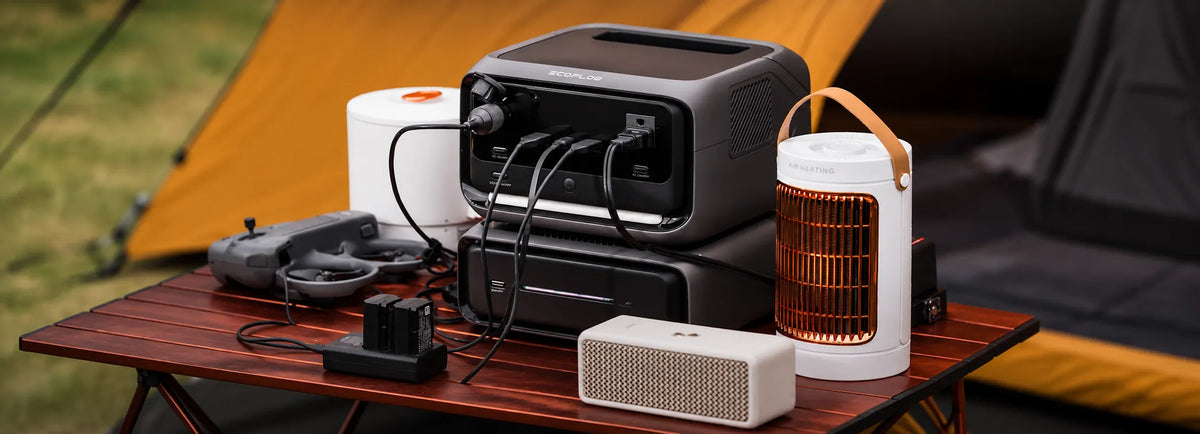
Blackouts during typhoons and power interruptions can disrupt daily life in Metro Manila. Portable power stations, solar panels, and hybrid systems offer reliable ways to keep essential appliances running. Discover their costs, runtime, and benefits to find the best backup power solution for your home.
Key takeaways
-
Portable stations work immediately: No installation required for standalone use. The EcoFlow RIVER 2 Max offers 512Wh of capacity and is listed at ₱22,990 at Altitude Philippines.
-
Solar extends your runtime: Quality solar panels can continue generating electricity on overcast days, although actual output will be lower than their rated capacity depending on cloud cover and sunlight conditions.
-
Hybrid setups provide extended coverage: A mid-capacity station paired with a solar panel can help households maintain essential power during longer outages, depending on battery capacity, energy consumption, and weather conditions.
-
Flood-prone areas face longer restoration challenges: Communities in Malabon, Navotas, and low-lying parts of Caloocan may experience additional power restoration challenges after severe flooding.
-
Match capacity to your outage pattern: Short, frequent brownouts need less battery than multi-day typhoon blackouts, so getting this right keeps cost reasonable.
Price note: All prices in this guide are based on the listings displayed on Altitude Philippines as of November 17, 2026. Prices, promotions, product variants, bundles, and stock availability may change without notice, so prices may be subject to change. Before you buy, open the linked product page to confirm the current price, what is included in the box, and whether the item is in stock.
Why Metro Manila, Philippines loses power so often, and who gets hit hardest
NCR outages come from several directions at once. Scheduled Meralco maintenance for line reconductoring, transformer replacement, and substation work is one of the most predictable causes, with interruptions varying depending on the work being performed. Severe weather during the June-to-November typhoon window is far less predictable: damage from flooding, wind, and debris can extend restoration from several hours to multiple days depending on how badly equipment is affected.
Equipment failures, foreign objects contacting distribution lines, and peak-demand stress during the March-to-May summer heat add to the picture. During the July 2025 monsoon flooding, roughly 118,000 Meralco customers lost power, with around nine out of ten affected households located inside Metro Manila, according to Philstar. That single event shows how quickly a weather system can overwhelm distribution infrastructure across the entire Greater Manila Area.
Which parts of Metro Manila experience the longest outages
Flood-prone, low-lying areas carry a higher risk of prolonged power interruptions during severe weather. Barangays in Malabon, Navotas, and parts of Caloocan may face longer restoration times because power cannot safely be restored until floodwaters recede, equipment is inspected, and damaged sections are repaired. Areas in Quezon City near Republic Avenue and Payatas Road, as well as parts of Pasig and Mandaluyong, may also experience interruptions during infrastructure maintenance and severe weather.
Residents can check Meralco scheduled interruption advisories to monitor affected areas and planned maintenance schedules.
Central business districts like Makati and BGC in Taguig may experience different outage patterns depending on the affected electrical infrastructure and severity of the incident. Restoration times can still vary, even within the same city. If your household sits in a flood-exposed barangay or an area with aging distribution lines, your backup setup needs to handle at least 12 to 24 hours without any grid input.
Extreme heat and prolonged power interruptions can make daily activities more challenging, especially for households that rely on electric fans, refrigerators, and internet connectivity. Learn more about preparing for brownouts and extreme heat during El Niño in the Philippines and the practical steps households can take to stay prepared.

What a portable power station can actually run in a typical Manila home
Filipino households think in appliances, not watt-hours, so here is how the numbers translate. A refrigerator running at roughly 120 watts with compressor cycling, two electric fans at 40 watts each, and a Wi-Fi router at 10 watts gives you a combined average load of about 180 to 250 watts. That load, more than anything else, determines your runtime.
EcoFlow uses an approximate 0.85 efficiency factor in its planning formula to account for inverter losses and battery management. Using that formula with a 215-watt midpoint average load, the RIVER 2 Max at 512Wh delivers about 2 hours of combined runtime for a refrigerator, two fans, and a router. A higher-capacity unit covering the same load extends that significantly. Always confirm that your chosen station can handle the startup surge of your refrigerator in addition to the combined running wattage.
|
Setup tier |
Best for |
Example from EcoFlow PH |
Starting price at Altitude |
Runtime note |
|---|---|---|---|---|
|
Compact station |
Short brownouts, renters |
₱22,990 |
Around 2 hours at a continuous 215W load |
|
|
Mid-capacity station + solar |
Longer outages, remote workers |
₱67,980 combined |
Additional daytime charging can help extend available battery power |
|
|
High-capacity system |
Larger household requirements, small businesses |
₱149,990 |
Higher-capacity expandable energy system; configuration and battery requirements must be checked |
Important: Prices are based on Altitude Philippines' displayed listings as of November 17, 2026. Availability, selected product variants, and promotional prices may change. The DELTA Pro Ultra AU displayed starting price corresponds to the Inverter AU version, not necessarily the complete inverter-and-battery kit. Prices may be subject to change, so confirm the current price, selected configuration, and included components on the product page before purchasing.
How much does it cost versus the downside of going without one
A mid-range EcoFlow portable station in the Philippines falls between roughly ₱22,000 and ₱58,000 depending on capacity, a one-time purchase. By contrast, a single extended blackout can mean spoiled food, lost income for remote workers who bill by the hour, and disrupted medical equipment for households with health needs. When you frame that one-time cost against recurring blackout losses, a portable power station stops looking like a luxury and starts looking like essential infrastructure.
Choosing the right capacity depends on your household's energy requirements and the appliances you need to keep running during a blackout. If you're still comparing different models, check out our portable power station buying guide to understand the differences between EcoFlow RIVER and DELTA series and find the right option for your needs.
Are solar panels worth adding to a Metro Manila, Philippines backup setup?
The common assumption is that solar does not work well in the Philippines because of rain and cloud cover. That assumption is not entirely accurate. Solar panels can still generate usable power on overcast days, although their output will be lower than their rated capacity depending on cloud cover and sunlight conditions. During non-typhoon months, Metro Manila receives strong sunlight that can help recharge a mid-capacity station, reducing reliance on the grid.
EcoFlow Philippines offers compatible panels, including the 45W Portable Solar Panel listed at ₱3,690 and the 110W Lightweight Portable Solar Panel listed at ₱9,990 at Altitude Philippines. The 45W product page is currently marked Sold Out, while the 110W panel is listed as an available product.
Adding a 110-watt panel to a compatible power station means you can harvest additional energy during the day while running your essentials. For most NCR households, a solar panel paired with a DELTA-series station provides more flexibility during prolonged outages, although actual charging performance depends on weather and energy consumption.
Weather conditions can also influence household energy consumption, particularly during prolonged hot and dry periods. For a broader look at the country's climate outlook, affected areas, and potential household impacts, read our El Niño Philippines 2026–2027 forecast and its effects.

What a hybrid setup looks like for a small household or remote worker
Picture a remote worker in Quezon City who needs an uninterrupted laptop, internet router, and phone charging through a rolling brownout. Or a small business owner in Parañaque who needs a refrigerator and POS terminal running during a typhoon-driven blackout. In both scenarios, a DELTA 3 paired with a 110-watt solar panel provides battery backup and an additional charging source during the day.
The solar panel effectively extends available energy without requiring a second battery unit. During peak sun hours, a 110-watt panel adds charge to the station while simultaneously supporting lighter energy requirements. During overcast periods, the panel still contributes at a reduced rate. The result is a more flexible setup for a household or small office during a prolonged outage, provided the overnight load stays within reason and typhoon-season cloud cover does not heavily suppress daytime generation.
For storm conditions and longer power interruptions, sizing conservatively with additional battery capacity or more solar input is the safer approach.
How to pick the right setup for your home in Metro Manila, Philippines
The simplest framework maps your outage pattern and budget to the right product tier. If your area experiences short, frequent brownouts of one to four hours, a compact station handles the job without overspending on capacity you will rarely need. If you live in a flood-prone barangay or regularly face typhoon-season outages stretching beyond eight hours, you need mid-to-large capacity paired with solar. Renters who want portability should stay with a station-only setup; homeowners who want a larger backup solution can look at higher-capacity systems across the EcoFlow Philippines range.
-
Short, frequent outages (1–4 hours): The RIVER 2 Max at ₱22,990 provides 512Wh of battery capacity for essential electronics, lights, routers, and compatible small appliances. Runtime will depend on the combined wattage of connected devices.
-
Full-day typhoon outages: The DELTA 3 at ₱57,990 plus a 110W solar panel at ₱9,990 gives you a combined listed price of ₱67,980. Its 1,024Wh battery provides more capacity for essential appliances, while solar charging can help replenish stored energy during daylight hours.
-
Extended or larger household needs: The DELTA Pro Ultra AU is listed at ₱149,990 for the Inverter AU version and supports expandable energy storage. Check the selected configuration and battery inclusion before purchasing.
Before you buy: The combined price for the DELTA 3 and the 110W solar panel is the sum of their two separate listings, not a fixed bundle price, and either listing may change on its own. Prices may be subject to change, and product availability may vary. Check each product page for the latest price, selected variant, and included accessories.
Frame the decision around your use case, not just wattage numbers. A freelancer who bills by the hour has different priorities than a family keeping food refrigerated during a 48-hour post-typhoon blackout. Both are valid needs, and EcoFlow Philippines has different product capacities designed for different requirements.
Where to get it and what to do next
EcoFlow Philippines serves the local market directly, with a product range covering different backup power requirements. At Altitude Philippines, you can explore portable power stations and compatible solar panels for different household needs.
If you already know which capacity fits your household, reach out to confirm compatibility with your specific appliances, ask about current promotions, and arrange after-sales support. If you are still deciding, start with your most critical appliances, estimate how many hours you typically go without power, and use those two numbers to find your tier.
The clearest path to staying powered through any blackout in Metro Manila, Philippines
Start with your outage pattern and your critical load. If you lose power for a few hours a month, a RIVER 2 Max covers smaller essential loads at an accessible price point. If typhoon season regularly knocks out your barangay for a full day or more, a DELTA 3 with a 110-watt solar panel provides a higher-capacity backup setup with additional daytime charging. For households or small businesses across the Greater Manila Area with larger needs, the DELTA Pro Ultra AU offers an expandable energy storage option.
Metro Manila residents do not have to accept blackouts as unavoidable disruptions to work, food safety, or family comfort. The next brownout or typhoon is coming, the only real question is whether your home will be ready when it does.
Browse the full EcoFlow Philippines product lineup at Altitude, check the latest promotions, or get in touch with the team to find the right fit for your home in Metro Manila, Philippines.
Frequently Asked Questions
Do we need an electrician to start using a portable power station during a blackout?
No, you do not need an electrician to use a standalone portable power station; plug in compatible appliances and power up immediately. We note that portable stations work immediately with no installation required, which makes them especially suitable for renters and quick blackout relief.
However, connecting a power station to your home's electrical circuits requires a properly designed transfer system installed by a qualified electrician. Never connect a power station to a household wall outlet to energize home wiring.
Will a portable station reliably handle my refrigerator's startup surge?
Possibly, but you must confirm the station can handle the refrigerator's startup surge in addition to running wattage. We point out that a typical refrigerator runs about 120 watts with compressor cycling and that startup surge capability is an important check when choosing any station.
As renters, should we bother with solar panels or stick to a station-only setup?
Renters should generally stick with a station-only setup for portability and ease of use, while homeowners looking for longer backup coverage can consider higher-capacity systems with compatible solar panels. We recommend station-only for portability and reserve solar or larger systems for those needing extended coverage.

Share: